

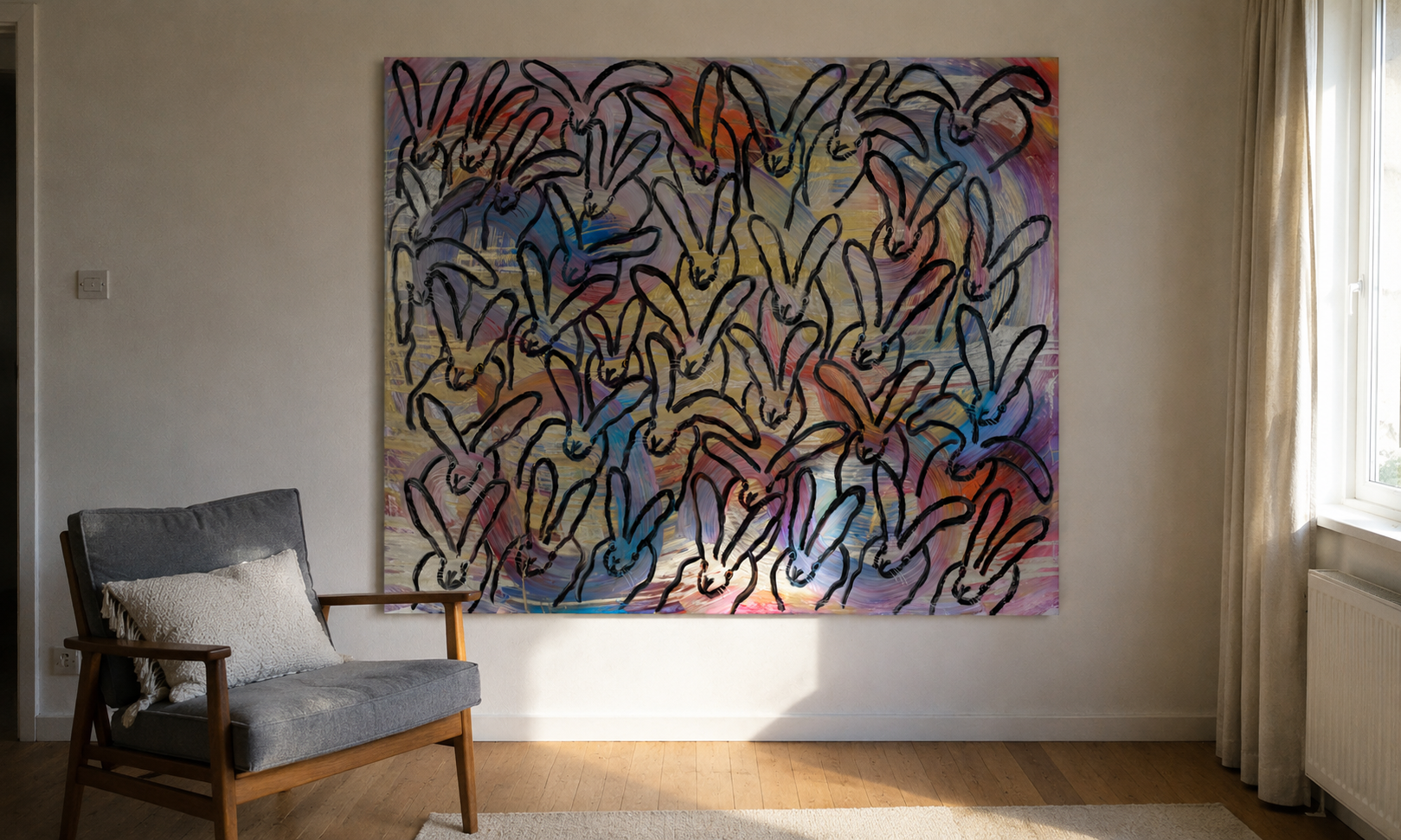
I bought my first piece of contemporary art when I was a teenager. At that point, I didn’t know it was called contemporary art. I certainly didn’t know if it was an asset, where the artist sat in art history, or what movement it belonged to. I just loved it.
I’ve been drawn to art ever since, and after spending most of my adult life in the art world, I think we make it more complicated than it needs to be. So if you’ve landed here curious about contemporary art, let’s start with the easy bit.
Contemporary art isn’t a style. It’s a period.
Broadly speaking, contemporary art means the art of our own era, usually made from the 1980s onwards and continuing today. Which means contemporary art can be almost anything visually. A beautifully painted portrait can be contemporary art. So can an abstract canvas, a bronze sculpture, an intricate etching, a photograph or, yes, a banana taped to a wall.
A lot of the confusion comes from a handful of art-world terms getting thrown into the same bucket. Here’s the simplest version.
Modern art doesn’t mean “modern” as in today. It refers to an historical period stretching from roughly the 1880s through to the 1960s or 70s. Think Monet, Picasso, Matisse, Pollock.
Contemporary art comes after that and continues into the present.
Avant-garde means art that is pushing against the accepted conventions of its time. What was avant-garde in 1910 may look thoroughly respectable hanging in a museum today.
Abstract art describes art that doesn’t attempt to represent the visible world. It’s a style or approach, rather than a period.
Conceptual art puts particular emphasis on the idea behind the work. Sometimes the idea matters more than the physical object.
When we say “contemporary art”, many people immediately picture its most provocative examples. Damien Hirst’s shark. Tracey Emin’s bed. Maurizio Cattelan’s banana. They make good newspaper stories.
Nobody writes a front-page headline saying:
But there are thousands of artists making work in almost every tradition imaginable. Some are deeply conceptual. Some care obsessively about craft. Some are figurative painters. Some make sculpture. You don’t need to like all of it. I certainly don’t.
in historical context, understanding what artists have made before, and assessing whether this piece adds something to the field.
Novelty is not (always) about shock. It’s about intellectually positioning
the work in relation to others. Like many fields, being a pioneer in the arts matters. This often produces conceptual art that people outside the art world struggle to appreciate, like Cattelan’s banana, ‘Comedian’. And whilst that may feel aloof, it carries intellectual consistency.
If you are thinking about buying contemporary art, I’d start where I did as a teenager: notice what draws your eye. Look around. And trust that response.Your taste will evolve, but that doesn’t make your experience today less legitimate. You probably like different wines today than you did a decade or two ago. Art gets richer by looking at more art.
Learn the Story
Once you find notice something that draws your eye, get curious. If you the like the story, consider buying. Otherwise don’t. Although art doesn’t ‘need’ a story, per se, in my experience, the difference between art you love for a year and art you love for a lifetime is the story behind it. The best art rewards curiosity. And the story gives you reasons to keep enjoying it. I’ve written much more about how I think about this in our Guide to Collecting Art.
How much should you spend?
You don’t need a huge budget. Start with the budget you’d be comfortable spending on a short holiday. I like this idea because, after a week’s holiday, you have memories. After you acquire a piece of art with a great story, you have something to love for a lifetime.
There is some terrific work by emerging artists at modest prices, and that’s where I would recommend anyone start. But I would make an important distinction: emerging art is so unlikely to ever be an asset, we might as well say never. That’s a different conversation, which I explore in When Is Art an Asset?
Gallery, artist or advisor
There are more ways to buy art than ever. You can walk into a gallery. Or discover an artist on Instagram and contact them directly. Both can work brilliantly. But obviously: the gallery represents the artist. The artist represents themselves. An advisor represents you.
The art world is like any complicated system, and if you’re new, you don’t know what you don’t know. An advisor is the only person in the art world that says ‘don’t buy that’. They can look across galleries, auction houses, artists and the secondary market and say, “I know you like this, but I think there’s something better for you over here.”
There’s a reason so many people are using advisors. LINK: Forbes Article
Hunt Slonem and Paul Wright are examples of two expressive, energetic painters at different stages in their career.
Hunt Slonem is an established American artist who has spent decades returning obsessively to birds, butterflies and his famous rabbits. The repetition has become part of the language of his work. His career, market and institutional history are already well established. And is currently, in my opinion, an artist one can explore as an asset. But a one meter square piece might be £50k.

Paul Wright is a British painter whose work has a completely different energy — bold, physical brushwork, somewhere between representation and abstraction. He has been selected twice for the BP National Portrait Award and has work in institutional and corporate collections. There’s a decent argument he could be where Hunt was 20 years ago. And a one meter square piece is currently closer to £10k.

If you don’t yet know where to begin, that’s exactly why we created our Taste Test. Rather than asking you whether you prefer Minimalism to Neo-Expressionism — which is a fairly ridiculous question if you’re new to all this — we simply show you art. You tell us what you like. Then we follow the clues.
That feels to me much closer to how a relationship with art should begin. Not with knowing all the right words. With looking.
I hope this was helpful.
Richard.
2026.
Contemporary art isn't a style. It's a period. Broadly speaking, it means the art of our own era, usually made from the 1980s onwards and continuing today. Which means it can be almost anything visually. A beautifully painted portrait can be contemporary art. So can an abstract canvas, a bronze sculpture, a photograph, or yes, a banana taped to a wall.
Modern art refers to a historical period stretching from roughly the 1880s through to the 1960s or 70s. Think Monet, Picasso, Matisse, Pollock. Contemporary art comes after that and continues into the present. Abstract art describes work that doesn't attempt to represent the visible world. Conceptual art puts particular emphasis on the idea behind the work, sometimes more than the physical object itself.
Start by noticing what draws your eye. Look around. Trust that response. Your taste will evolve, but that doesn't make your experience today less legitimate. Art gets richer by looking at more art.
Art doesn't need a story, per se. But in Richard's experience, the difference between art you love for a year and art you love for a lifetime is the story behind it.
Start with the budget you'd be comfortable spending on a short holiday. After a week's holiday, you have memories. After you acquire a piece of art with a great story, you have something to love for a lifetime.
Featured Posts
-

A Guide to Collecting
... -
The Nugget Test
... -

Is This Art? – Baruch Torgeman and the Language of Books
Is This Art? – Baruch Torgeman and the Language...
